
When walking through one of our Career and Technical Education centers, you’ll be sure to hear everything from welders and hammers to blow dryers and bulldozers. Or you can expect to smell everything from cookies and soup to nail polish and sawdust.
But aside from the sights, smells and sounds of a tech center, there’s something being utilized that you may not necessarily pick up on right away: Artificial Intelligence (AI).
With advances in technology, AI has taken the world by storm, and our CTE sites are staying ahead of the curve, using it to enhance teaching and learning capabilities.
“Integrating AI into our CTE programs gives students real-world skills they will use in today’s workforce, while providing teachers with tools to enhance lesson planning, create clear rubrics, and strengthen instruction,” said Brittany Atkinson, Principal of Finger Lakes Technical and Career Center in Stanley.
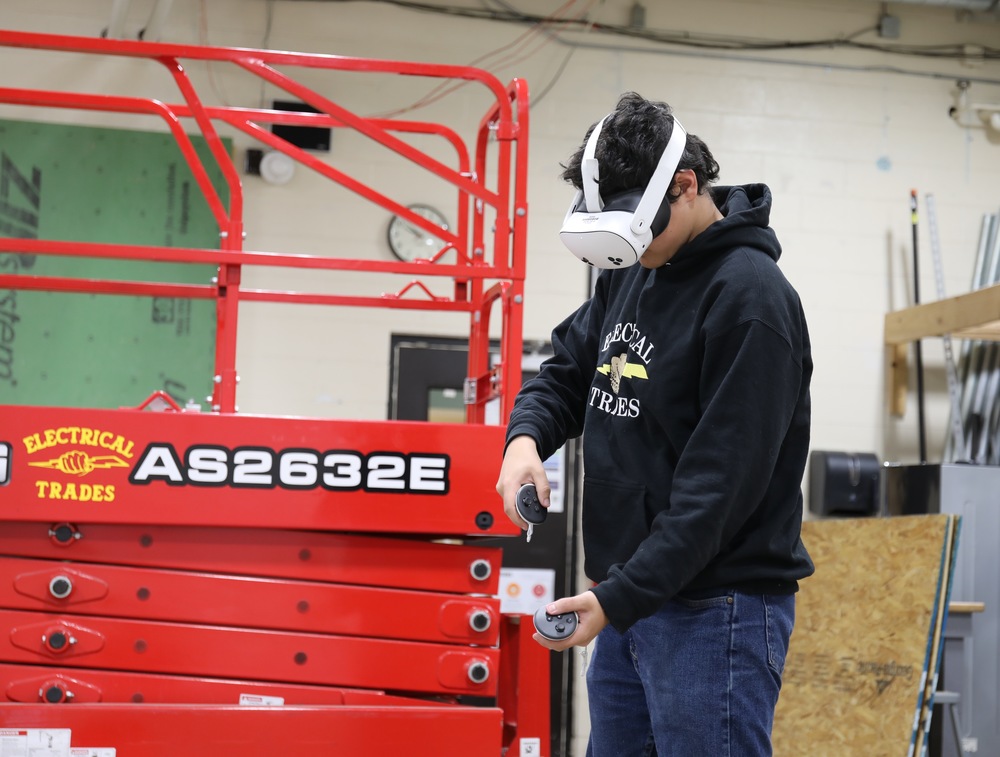
For example, students in the Electrical Trades program have used VR headsets to simulate real-life scenarios. Classroom lessons in the New Vision program are being transcribed with AI, and students are using the transcript to revisit key points, terms and definitions from the classroom dialogue.
“AI, in this use, kind of simplifies students having to be strong stenographers and allows them to focus their attention on what the teacher is instructing and saying, giving them the flexibility to review it later after everything's been digested,” said Andy McVey, Principal of Wayne Technical and Career Center.
CTE instruction also isn’t always done conventionally, especially depending on the material or program, said McVey. AI has helped many teachers craft lesson plans to maximize the impact they’re making in the classroom.
“Where we really started focusing on AI was how to use it to create plans and materials for and by folks that are not classically-trained teachers, something that might be better for someone who went to college for four years and is a master of pedagogy," McVey said. "AI then allows them to do a lot more to make information accessible in the classroom."
It has also been useful in meeting students where they’re at in terms of different learning abilities. For example, the Advanced Manufacturing and Engineering program has multiple ProtoTRAK systems in their machine shop. These machines come with 22-step setup procedures designed for adults in this career field. Teachers in the program have been able to utilize AI to take those 22-step procedures and break them down into something understandable for a high school-aged student.
Another factor to consider is the ability of AI to pull information from multiple sources to come up with a list of standards or procedures. It can help bridge CTE standards with academic standards, reinforcing math, science, literacy, and critical thinking within hands-on learning.
“We’ve looked at it to strengthen our cross-curricular standards,” said Atkinson. “If we look at the standards for, let’s say AME, and cross them with math and science standards, we can use that to identify New York State approvals and learning objectives."
So, while making use of AI may be daunting to some, our teachers and students have found ways to successfully integrate it into everyday use, making the most of their time in career and technical education and preparing them for a future where AI is sure to remain for the foreseeable future.
“AI increases accessibility by offering different ways for students to access content, receive support, and demonstrate their understanding," Atkinson said. "Together, this supports our students in being prepared, confident, and career-ready."